Democracy’s Documents: Edward Kennedy: Faith, Truth and Tolerance in America
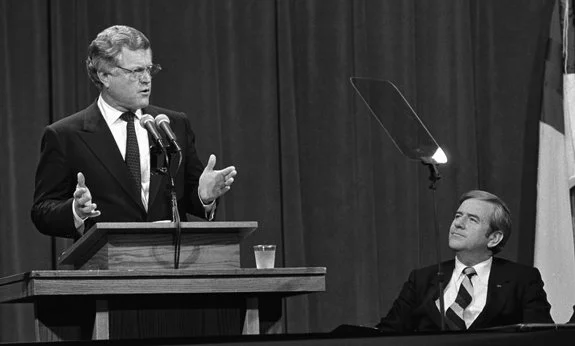
On October 3, 1983, Senator Edward M. Kennedy, a leading liberal voice of the Democratic Party, heir of the Kennedy legacy and a Catholic, gave a speech at Liberty Baptist College (now Liberty University) in Lynchburg, Virginia. His invitation from Rev. Jerry Falwell, leader of the conservative Christian political organizatio the Moral Majority, struck many on both ends of the political spectrum as odd. It was both accidental and deliberate. Kennedy had mistakenly received a Moral Majority membership solicitation. Cal Thomas, Falwell’s aide, apologized but also invited Kennedy to visit the campus. Kennedy said he’d be happy to come and proposed giving a speech. Falwell welcomed that. Kennedy’s speech is a useful reminder of how faith and democracy can both thrive when we keep in mind their strengths and proper relationship.
Understanding the disagreements that separated him from his conservative audience, Kennedy began with a plea for humility, for recognizing our own fallibility. Recalling Jesus’s advice (Matthew7:3-5), he said that “even the disciples had to be taught to look first to the beam in their own eyes, and only then to the mote in their neighbor’s eye.” He acknowledged his limitations in a request for mutual respect:
“I do not assume that my conception of patriotism or policy is invariably correct – or that my convictions about religion should command any greater respect than any other faith in this pluralistic society.”
With that he turned to the “deeper and more pressing question – which is whether and how religion should influence government.” He recalled presidential candidate John F. Kennedy’s speech to the Greater Houston Ministerial Association at the height of the 1960 campaign, amidst charges that a president who was Catholic would follow the Pope’s bidding: “I believe in an America where there is no (religious) bloc voting of any kind.”
Yet, he added, that does not mean that there is “an absolute separation between moral principles and political power.” That separation, however:
“can sometimes be frustrating for women and men of religious faith. They may be tempted to misuse government in order to impose a value which they cannot persuade others to accept.” Yet that can lead to “a slippery slope where everyone’s freedom is at risk. . . . Let us never forget today’s Moral Majority could become tomorrow’s persecuted minority.”
Kennedy next highlights a key distinction. There are, he says, “uniquely personal parts” of our lives, in which “the proper role of religion is to appeal to the conscience of the individual, not the coercive power of the state.” There are “other questions which are inherently public in nature, which we must decide together as a nation, and where religion and religious values can and should speak to our common conscience.” In such cases, “we recognize that the city of God should speak to the civic duties of men and women.” Kennedy proposes four tests to apply to find the proper roles of individual conscience and religious faith in public life.
“First, we must respect the integrity of religion itself.” Avoid using religion, he says, to sanction behavior, such as prejudice, that is antithetical to religious values. At the same time, “[R]eligious values cannot be excluded from every public issue but not every public issue involves religious values.”
“Second, we must respect the independent judgments of conscience. Those who proclaim moral and religious values can offer counsel, but they should not casually treat a position on a public issue as a test of fealty to faith.” Here he notes that the name Moral Majority “seems to imply that only one set of public policies is moral and only one majority can possibly be right.” He also warns against any religious test, “directly or indirectly” for a seeker of public office, including “where they worship, whether they follow Christ or Moses, or whether they are called “born again” or “ungodly.””
“Third, in applying religious values, we must respect the integrity of public debate. In that debate, faith is no substitute for facts.” The standard for debate, Kennedy states, must avoid claiming the infallibility of one’s argument or assume that any argument will do “whether it is false or true.” Quoting Pope John, he adds that “We must beware of those who burn with zeal, but are not endowed with much sense.”
“Fourth, and finally, we must respect the motives of those who exercise their right to disagree. We sorely test our ability to live together if we readily question each other’s integrity. . . the more deeply felt they [our feelings] are, the greater is our obligation to grant the sincerity and essential decency of our fellow citizens on the other side.” “Dr. Falwell is not a “warmonger,” he says, and “liberal Clergymen are not . . . “equivalent to “Soviet sympathizers”” because they have different views on the issue of a nuclear freeze.
Moving to conclude, Kennedy offers a vision where faith, truth and tolerance co-exist:
“In short, I hope for an America where neither fundamentalist nor humanist will be a dirty word, but a fair description of the different ways in which people of goodwill look at life and into their own souls. I hope for an America where no president, no public official, no individual will ever be deemed a greater or lesser American because of religious doubt or religious belief. I hope for an America where the power of faith will always burn brightly but where no modern inquisition of any kind will ever light the fires of fear, coercion or angry division. I hope for an America where we can all contend freely and vigorously, but where we will treasure and guard those standards of civility which alone make this nation safe for both democracy and diversity.”
Photo Credit: Les Schofer, Courtesy of Liberty University
(If you do not currently subscribe to thinkanew.org and wish to receive future ad-free posts, send an email with the word SUBSCRIBE to responsibleleadr@gmail.com)