Democracy’s Documents: Walter Lippmann: Speech to the Harvard Class of 1910 at Their Thirtieth Reunion*
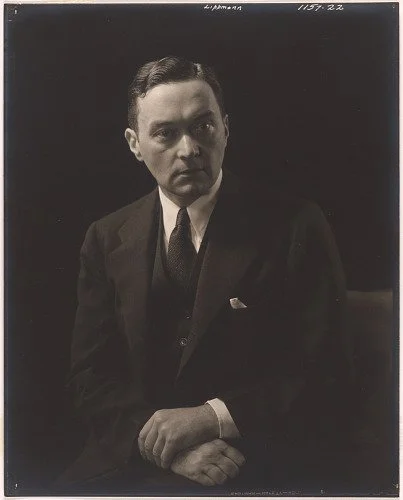
Walter Lippmann was a noted journalist, author and political commentator. On June 18, 1940, as France was about to fall to Nazi Germany, he returned to his alma mater to speak to the Harvard Class from which he had graduated. He challenged them to return to the hard work of citizenship that built a nation and was once again essential to save it and Western civilization. It is a message that still speaks to Americans.
“We have come back to Harvard,” he began, “and when we go away . . . we shall realize what it is that is threatened with destruction, what it is that we are called upon to defend.” “And by being together,” he continued, “we shall remember that we are not mere individuals isolated in a tempest, but that we are members of a community – that what we have to do, we shall do together.”
Lippmann told his reunion that “this is a solemn hour in the history of the modern world. No one here today will imagine he can divert himself by forgetting it.” If we are to save the world as it “roars and rages about us,” he continued, we must know that the peace of mind we seek “comes to men only when, having faced all the issues clearly and without flinching, they have made their decisions and are resolved.”
Lippmann then faulted his audience:
“You have lived the easy way; henceforth, you will live the hard way.” . . . “You came into a great heritage made by the insight and the sweat and blood of inspired and devoted and courageous men; thoughtlessly and in utmost self-indulgence you have all but squandered this inheritance. Now only by the heroic virtues which made this inheritance can you restore it again.” . . . “You took the good things for granted. Now you must earn them again. . . .”For every right you cherish, you have a duty you must fulfill. For every hope that you entertain, you have a task that you must perform. For every good that you wish to preserve, you will have to sacrifice your comfort and your ease.”
Lippmann castigated the Western world for its failures after World War I. “For twenty years the free peoples of the Western world took the easy way, ourselves more lightheartedly than any others. . . . That is why we find ourselves today knowing that we here in America may soon be the last stronghold of our civilization.”
Yet defending against the danger to civilization is not enough: “more than that, more than the center of resistance, we mean to make” America “the center of the resurrection, the source of the energies by which the men who believe as we do may be liberated, and the lands that are subjugated redeemed, and the world we live in purified and pacified once more.” Yet:
“In 1917-1918, we participated in a war which ended in the victory of the free peoples. It was hard to make a good and magnanimous peace. It was easier to make a bad and unworkable peace. We took the easiest way. . . . the way that required us to do nothing, and we passed resolutions and made pious declarations saying that there was not going to be any more war, that war was henceforth outlawed.”
“So enchanted were we with our own noble but inexpensive sentiments that, though the world was disorganized and in anarchy, we decided to disarm ourselves and the other democracies. That was also the easy way.”
Lippmann then argued that this led to a failure of a “workable settlement of reparations and of the war debts. It was easier to let them break down and wreck the finances of the world. . . . It was too much trouble to work out arrangements for the resumption of trade because it was too much trouble . . . It was easier to finance an inflationary boom by cheap money than it was to reestablish trade based upon the exchange of goods.” And we let that inflationary boom turn “into a crash that threw about twenty-five millions, here and abroad, out of work, and destroyed the savings of a large part of the people of all countries.”
The collapse of the world economy, Lippmann continued, “produced at the foundations of Western civilization a revolutionary discontent. . . . But it was hard to make the effort and the sacrifice to remedy the discontent. And because it was hard, we did not do it.”
This discontent led in Europe and Asia to “an organized rebellion against the whole heritage of Western civilization. It was easy to disapprove, and we disapproved. But it was hard to organize and prepare the resistance: that would have required money and effort and sacrifice and discipline and courage. We watched the rebellion grow.” We abhorred its “savage crimes,” but liking our jobs, profits and pleasures “we said, It is bad, but it won’t last; it is dangerous, but it can’t cross the ocean” and to arrest it we would “be taking risks, and that is more trouble than we care to take.”
The result is that there “is organized mechanized evil loose in the world” made possible by “the lazy, self-indulgent materialism, the amiable, lackadaisical, footless, confused complacency of the free nations of the world.” The current disaster:
“is ultimately a disaster in the character of men. It is a catastrophe of the soul of a whole generation which had forgotten, had lost, and had renounced the imperative and indispensible virtues of laborious, heroic, and honorable men.”
Yet there is hope if:
“We shall turn from the soft vices in which a civilization decays; we shall return to the stern virtues by which a civilization is made, we shall do this because, at long last, we know that we must, because finally we begin to see that the hard way is the only enduring way.”
* No online copy of the speech is available but you can listen to a reading of the full text at: https://www.youtube.com/watch?v=wx69-50VJMg
Photo Credit: National Portrait Gallery