Profiles in Character - Abraham Lincoln Adheres to the Constitution to Emancipate Slaves
“I hate it because of the monstrous injustice of slavery itself. I hate it because it deprives our republican example of its just influence in the world,” Abraham Lincoln told a Peoria audience on October 16, 1854. Yet while wanting slavery’s end, as president he could not simply declare slaves free. The Constitution left that up to each state. If he did:
“Would I thus not give up all footing upon the Constitution or law? Would I not thus be in the boundless field of absolutism?”
In his First Inaugural Address devoted to saving the Union before the Civil War began he said "I have no purpose, directly or indirectly, to interfere with the institution of slavery in the States where it exists. I believe I have no lawful right to do so." He intended to prevent its westward expansion but sharing racial prejudices of his time also believed free blacks and whites could not live together. New Western states he believed should be free for whites. Freedmen would be encouraged to leave for colonies outside the United States.
Abolitionists were angry when Lincoln didn’t emancipate slaves at the onset of the war. Yet the Border States (Maryland, Delaware, Missouri, Kentucky) were slave states and if he did they might well join the Confederacy to protect their “property.” He also knew most in the North were willing to fight to preserve the Union not to free slaves who they feared would take their jobs and might, driven by revenge, engage in racial warfare.
The war presented early emancipation opportunities (expertly detailed in Allen Guelzo’s Lincoln’s Emancipation Proclamation), but Lincoln opposed them. In May 1861, Major General Benjamin Butler accepted and freed slaves who came within his lines after their “owners” had fled, calling them “contraband of war.” Lincoln found no law allowing them to remain free once the war ended. On August 30, Major General John C. Fremont, using the Confiscation Act Lincoln had signed recently, declared martial law throughout Missouri with the provision that slaves could be confiscated from any Confederate supporter and declared free. Lincoln fired him for exceeding his legal authority. In April 1862, Major General David Hunter declared martial law along the Southeast Coast and not only freed slaves but formed them into squads and issued them weapons. Lincoln voided Hunter’s actions.
Lincoln’s opposed these moves not only because the Constitution gave the states the power to manage their domestic affairs but because any acts to free them would grant only temporary emancipation which slave states might well end after going to court to get their slaves back when the war ended.
Having rejected contraband, confiscation and martial law, Lincoln offered his approach: gradual emancipation by state law with owners compensated by the federal government and freedmen colonized outside the country. Slaveholders rejected this, abolitionists attacked the idea and freed blacks had no desire to leave America. Lincoln was still searching for a Constitutional solution to end slavery.
A war with too few Union victories by mid-1862 led Lincoln to speculate if the “will of God” did not take sides in the war and that God must have some other goal. That and the depletion of Union forces opened a new path. Saving the Union and emancipating slaves, he concluded, could no longer be unconnected goals. As Commander in Chief he believed his war powers and military necessity sanctioned emancipation, both to weaken the South and bring freed blacks into the Union army. It was, as he said, the “last card” he had to play.
Calling his Cabinet together on July 22, he read them a draft of an emancipation proclamation. Secretary of State William Seward urged that he postpone issuing it until after a battlefield victory lest in look like an act of desperation. That victory came at Antietam, Maryland on September 17th.
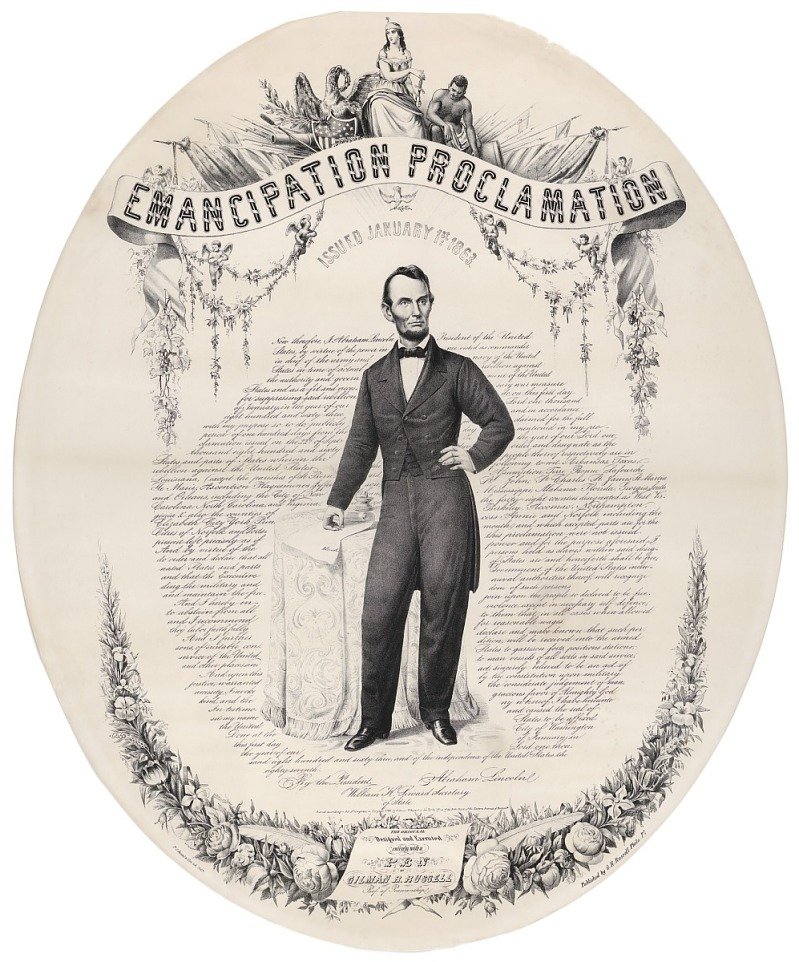
Yet he still offered compensated emancipation – at least for three more months. In a Preliminary Emancipation Proclamation on September 22 he said that on January 1, 1863, “all persons held as slaves within any State, or designated part of a State, the people whereof shall be in rebellion . . . shall be then, thenceforward, and forever free.” The final version on New Year’s Day also pledged the government would “recognize and maintain” that freedom including by military force, and it invited free blacks into the Union Army. If freemen “stake their lives for us,” Lincoln said, “the promise [of freedom] being made, must be kept.” The final Proclamation no longer spoke of compensated emancipation or colonization.
As Guelzo notes, Lincoln took a political risk with the Preliminary Emancipation Proclamation coming so close to the 1962 Congressional elections. He took an even greater risk with the final Proclamation, not knowing if Union soldiers would abandon a war now transformed into one to also end slavery or if parts of his war coalition might desert him.
The Proclamation exempted the Border States as they were not in rebellion and war powers could not constitutionally be extended to them. That would take the 13th Amendment which abolished slavery and thus prevented states from using courts to reclaim their former slaves after the war.
The Emancipation Proclamation, though hailed by abolitionist leader William Lloyd Garrison as “sublime in its magnitude, momentous and beneficent in its far-reaching consequences,” did not end racial animosity in America. But it did help some appreciate the magnitude of Lincoln’s challenge and his mastery of freeing four million slaves while upholding the Constitution. Abolitionist Frederick Douglass grasped this. Speaking at the dedication of the Washington, D.C. Freedmen’s Monument on April 14, 1876, he noted of Lincoln:
“Had he put the abolition of slavery before the salvation of the Union,
he would have inevitably driven from him a powerful class of the American
people, and rendered resistance to rebellion impossible. Viewed from the
genuine abolition ground, Mr. Lincoln seemed tardy, cold, dull, and indifferent: but measuring him by the sentiment of his country, a sentiment he was bound as a statesman to consult, he was swift, zealous, radical, and determined.”
Photo Credit: National Portrait Gallery