A Father's Day Remembrance
In his eightieth year, my maternal grandfather, who everyone called “Pop,” gave my girlfriend $10. We were heading to Vernon Downs, a horseracing track not far from Syracuse, New York. “Bet it on ‘Our Dream,’ he said, a horse in the fifth race. Maybe it was the romantic in him. That girl, who became my wife, bet it all to win on that longshot – who did win. I think Pop’s gesture said even more about his life then our future one.
His name, at least as Ellis Island recorded it in May, 1907 when he arrived on the Moskwa, was Berko Kessel, which would soon morph to Barney Kassel.
His father, Naech Yankel, was born in a Polish-Jewish shtetl, though whether it was in Poland or Russia depended on where the Russian army advance was at the time. My great-grandfather spent the bulk of his adult life in that army, not by choice, because when they took you, you were free only after 25 years.
Pop, born in January 1884, was apprenticed to a blacksmith at 13. At 21, he also was taken into the Russian army. To avoid his father’s fate took ingenuity. Stationed near the Turkish border, he knew that if you ate lots of beets your urine would turn red. When it did, the camp doctor declared him sick and sent him to the hospital tent. As he also knew, that tent was at the edge of the camp. In the middle of the night he crawled under it, crossed the border and eventually made his way to Libau, Latvia, from where the Moskwa sailed.
He left behind his wife, who he had married after seeing her enchanting photograph in a shop window and finding her with the owner’s help. He brought her to America a year later, after earning her passage. He sent money overseas for other family to follow.
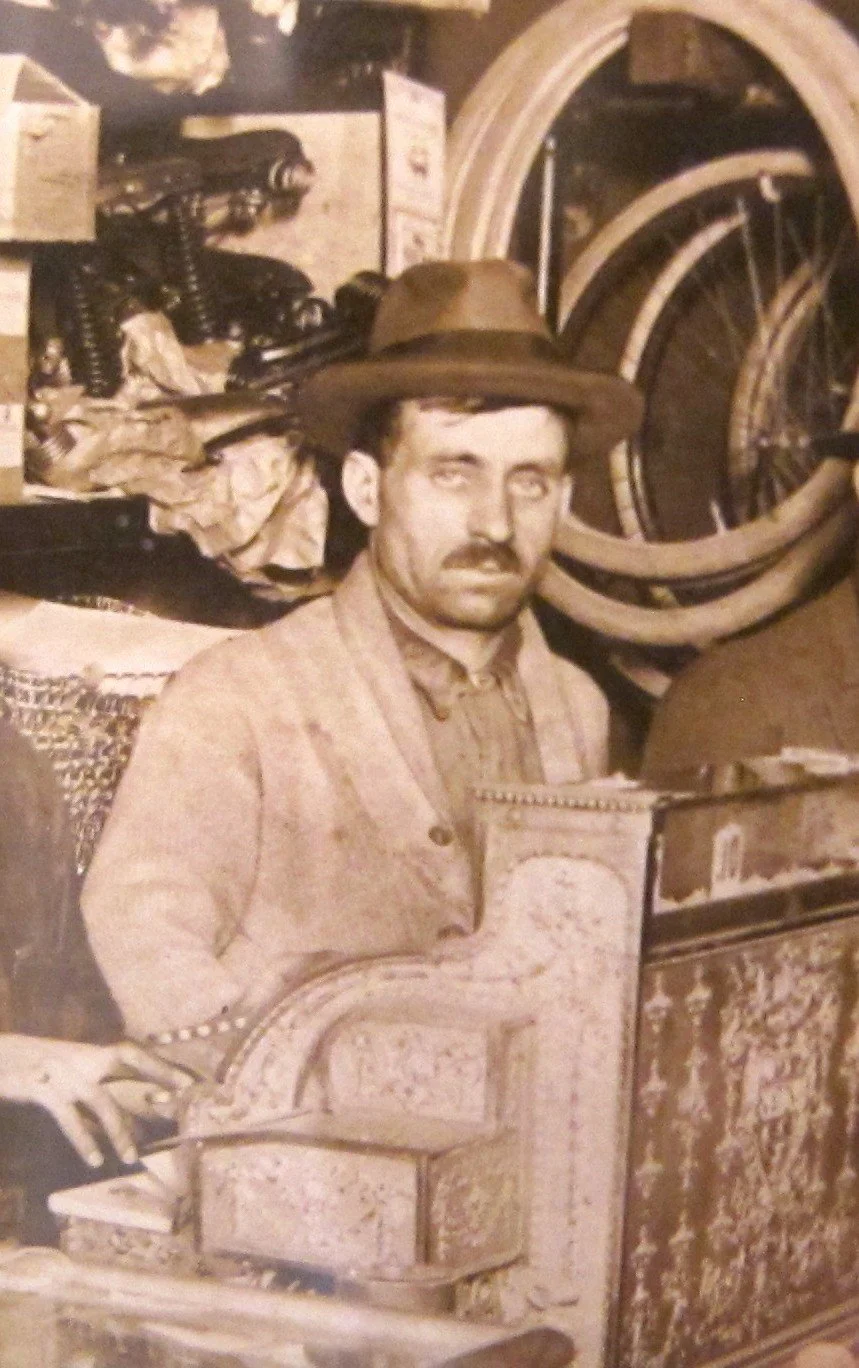
You could not enter America if you were penniless, but he did with the gift of one dollar from the Jewish Aid Society. He made his was to Syracuse, New York where a cousin lived. With his blacksmith skills he made hinges for Stickley furniture. Then, seeking his own fortune, he went from owning a hot dog stand to a bicycle shop and finally to Kassel Auto Parts, the largest dealership of its kind in the city and which supported his family and the families of his two sons.
In my youth, I was not aware of his story and I enjoyed Pop best for his wry smile, gentle manner and sense of humor. When my brother and I were both kids, he said he wanted to give us each $10 but only had a $20.. So, to our shock, he tore it in half. When were young men, he would gather all the boys in a corner of the room at Thanksgiving dinner and tell risqué jokes.
Yet the story that I love best came in his old age. We visited him in South Beach, Florida where he went each winter. He assured us he was fine but said someone had recently stolen his wallet from his back pocket. We urged him to keep it in this front pocket from now on, which he said he did. He also said he bought another wallet to keep, empty, in his back pocket. Well, not exactly empty, because told us he put a note in it on which he had written for some future thief: “Go to hell.”
I believe that sense of determination fueled the tank of what it took to escape poverty, cross an ocean, make a new, successful, happy life, and persist in the face of losing three wives to heart disease and cancer. In his journey he saved not only himself but all those he paid to bring here who, but for him, would have perished in the Holocaust. Without him, I would not be here to tell his story.
In his last few years he lived with my parents. During one of our visits he came downstairs after dark with his car keys in his hand. “Pop,” Mom said, “you know you can’t drive at night.” “That’s why I need the practice,” he said and off he went.
The last time we saw him, in what would turn out to be the last month of his life is his 89th year, he sat on the floor and played with his toddler great-grandson. When it came time for us to leave, he did not want to let our son go. He hugged him tightly for what he knew would be the last time - a hug that encompassed nearly a century of family life. “I am ready to go,” he told me during that visit.
Thinking back on that moment, I recall the three-fold Hebrew blessing he carried with him from his father, his father’s father and down through antiquity, and that he bestowed, in Hebrew, on my brother, the eldest grandson:
“May God bless you and keep you.
May God shine light on you and be gracious to you.
May God turn toward you and grant you peace.”
Being the product of his European heritage, he didn’t bless the girls. He loved them nonetheless, and Pop’s life and gifts to all of us were the blessing we treasured most.
Photo Credit: Unknown