The Supreme Court as a Civic Classroom
In 1987, 76 percent of Americans had a favorable opinion of the Supreme Court. By 2025, only 48 percent did. As the nation has become more polarized, views of the court are increasingly driven by whether its decisions agree with one’s politics. The legitimacy of the Court is at stake. It counts on the public to accept its decisions, even when we disagree with them, especially as the Court cannot implement its own rulings. As Alexander Hamilton noted in Federalist #78, it has “neither force nor will, but merely judgment.”
Yet evaluating the Court solely by a political yardstick misses an important role it plays. The Supreme Court can serve as one of democracy’s classrooms. Even those who disapprove of the Court and a particular decision can learn from it how to be better citizens. At its best it’s the way the Court does its work that is the teacher about how we ought to deal with confronting contentious public issues.
The Court models civility. While often criticized as being slow to render decisions, the Court’s deliberate process can help cool the passions of what Thomas Jefferson called our “boisterous sea of liberty.” The Court’s insistence on decorum and respect for other justices and as well for opposing participants in arguments offers a lesson on respecting different viewpoints and each other, both key elements of what the founders called “public virtue.” Justices may strongly disagree, but they do so civilly.
The Court shows how to structure an argument to support a point of view. For cases it accepts, which are most often appeals of lower court rulings, the Court requires contending briefs from petitioners who seek relief and from respondents to them. It also accepts “friend of the court” (amicus curiae) briefs from individuals and groups with an interest in the case. The expectation is that all these briefs are anchored in solid reasoning, the law, American history and the Constitution. If you want the Court to take you seriously, the message is to be serious. Appeals to partisanship and popular emotions, which value passion over reason, may appear but are constrained by guardrails against their abuse.
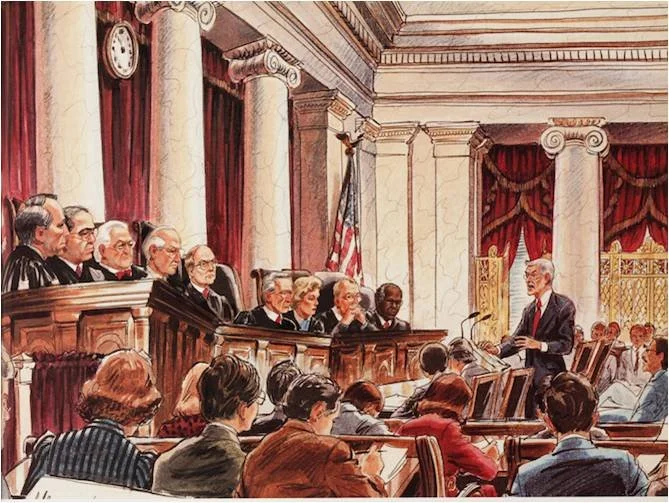
Oral arguments exemplify how to debate. Oral arguments are public and, through transcription and video, accessible to those who can’t attend. Justices and their clerks, having studied all briefs, lower court opinions and other sources, ask probing questions to identify strengths and weaknesses in arguments. These questions may raise overlooked issues and points of view. Lawyers from both sides, preparing for the short time they are given before the Court, must know weaknesses in their presentation, in their opponent’s case and anticipate questions. They must also argue civilly.
Justices work collegially to reach a decision. After oral arguments, justices meet to discuss the case and vote on a decision. As arguments are made, reaching consensus may not be possible. One justice then writes the majority opinion. The draft of that opinion is circulated among all justices, whose comments and suggestions may lead to rewriting the opinion, further rounds of circulated drafts, and sometimes even a change in how a justice votes. This continues until a majority of the Court accepts the opinion. Justices may also write concurring or dissenting opinions to add other elements of their reasoning.
The Court’s decision and its reasoning are made public. This includes the majority, concurring and dissenting opinions, once again modeling diversity of thought, respect for alternate views and the importance of careful reasoning. The availability of these documents signals the importance of transparency in a democracy.
The Court’s process demonstrates attention to history. The full record of the case becomes part of American history. It’s available for study and use in the education of lawyers, Constitutional scholars and the broader public. Its references to the Constitution, the rule of law, history and core democratic values are invaluable resources in current and future discussion of public issues, including outside the court and all across America.
The Court may signal its own fallibility and in doing so the importance of humility. At times, the Court may acknowledge past rulings have erred. American history contains powerful examples. In 1896, the Court ruled 7-1 in Plessy v. Feguson that “separate but equal” facilities could be used to segregate black railroad riders in separate cars from those reserved for white passengers. Justice John Marshall Harlan wrote the lone dissent: “there is in this country no superior, dominant ruling class of citizens. There is no caste here. Our constitution is color-blind, and neither knows nor tolerates classes among citizens. In respect of civil rights, all citizens are equal before the law.” This dissent, as Court dissents sometimes do, would help correct democracy fifty-six years later in Brown v. Board of Education which overturned the separate but equal doctrine and helped launch the end of legal segregation in America.
For our hyper-partisan, over-emotional politics, the Supreme Court offers valuable teachings on how to be civil, argue with facts, respect people and views with which we differ, make a case thoughtfully, acknowledge dissenting views and doing so with transparency so as to take democracy out of the shadows which contribute to lack of trust in government and each other. The Court, if it acts with humility, can also teach us what Justice Harlan said in defending his conversion from a defender of segregation before he reached the Court to an advocate for equal rights when he sat on it: “Let it be said that I am right rather than consistent.”
Photo Credit: www.lindahall.org
(If you do not currently subscribe to thinkanew.org and wish to receive future ad-free posts, send an email with the word SUBSCRIBE to responsibleleadr@gmail.com)