
Corrupting Democracy
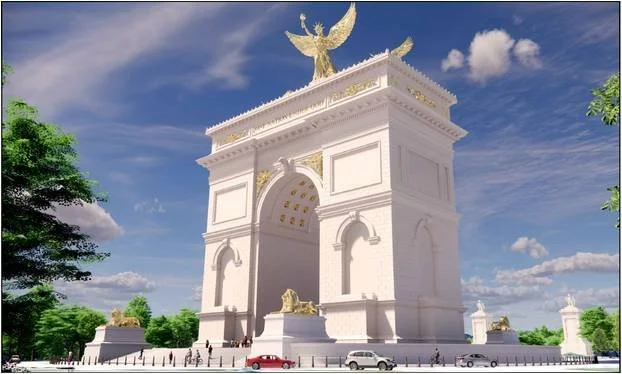
In the fall of 2025 President Trump proposed constructing a triumphal arch in the nation’s capital. A reporter asked who it was for; he answered “Me.” At 250 feet, the White House soon described the arch as a commemoration of America’s semiquincentennial birthday. Last February he said it would be a symbol of American greatness: “We’re doing one that will be more magnificent and larger than the Arc de Triomphe in Paris.” More recently, amidst criticism regarding architectural, historical, cultural and legal issues he said: “[A]t the strong request of the United States Military, and for National Security purposes, I have agreed to convert the magnificent Triumphal Arch ... into a top grade Military Complex/Triumphal Arch” to house drones, ammunition and snipers.
“Corruption in government” is usually associated with illegal actions by public officials to benefit themselves or others. That’s too narrow a view. Even actions within the letter of the law can undermine democracy, and public officials sometimes act immorally under laws they pass or interpret to their benefit. We need a broader definition of corruption. The dictionary helps. To corrupt (as a verb) is to “destroy the integrity of, cause to be dishonest, debase, lower morally, or taint.”
Public leaders have an obligation to abstain from acting corruptly by this broader meaning as well. It honors the republican virtues of our founding. Public virtue matters as James Madison said in Federalist #57: “The aim of every political constitution is or ought to be first to obtain for rulers men who possess most wisdom to discern, and most virtue to pursue, the common good of the society and in the next place, to take the most effectual precautions for keeping them virtuous whilst they continue to hold their public trust.”
Public virtues include as a minimum acting with honesty, integrity, self-restraint, humility, protecting human dignity, concern for the common good, fostering justice, fidelity to the Declaration of Independence and the Constitution and adhering to the rule of law. These are the same virtues for which we praise people such as Washington and Lincoln
The President’s actions regarding the arch corrupt democracy. With hubris he admits the arch is a vanity project (for “Me’). He disregards the need for Congress, the peoples’ representative, to authorize it. He corrupts the process for public input by staffing advisory bodies with hand-picked supporters. He evades the spirit as well as the law of the National Historic Preservation Act even as his own National Park Service has identified 42 historic properties that would be adversely impacted. His ongoing redefinition of the arch’s purpose disregards the honesty and integrity that should govern a major change to the nation’s capitol. The grandiosity of the arch – taller than the Lincoln Memorial - violates the self-restraint that is a hallmark of republican virtue for which capital architecture is known and should guide a public servant. Neither is the arch needed to serve the public good. Washington, D.C. already has many monuments celebrating republican values and American greatness. Many would be tainted by the arch as it towers above them. The arch also militarizes a site in a peaceful setting. No credible threat of violence requires drones and snipers near tourists and a national cemetery. Who would the snipers and drones attack?
This focus on the arch may seem to some a rather trivial example of corrupting democracy. Yet it is part of a much wider pattern of corrupt acts.
The President, though Constitutionally required to faithfully executive the laws, has spent public funds for purposes not authorized by Congress and has evaded spending money appropriated for specific needs he does not like. He has launched a war against Iran without Congressional authorization. He has cast doubt on the integrity of federal elections without verifiable evidence of significant fraud. He has criticized election officials without justification, leading to threats against their safety. He has undermined confidence in rigorous science. He has corrupted the public service via massive firings of civil servants without cause. He has shuttered agencies and programs without Congressional approval. He has undermined trust in the fair administration of the laws by using the Department of Justice to investigate and indict political enemies. He has corrupted the IRS by extracting a deal to protect himself and his family from tax audits. He has arrested and detained American citizens wrongly accused of being illegal immigrants. He has forcefully arrested and deported immigrants here legally as they reported for court-ordered hearings.
Corrupt acts by those in government strike at the core of democracy in less obvious ways as well. They threaten to normalize behavior that undermines the rule of law and the moral foundation for laws and the Constitution as such behavior becomes seen as “well, we’ve done this before.” Corrupt acts weaken the Congress and its oversight mechanisms. They foster cynicism and loss of faith in democracy among citizens, justifying some to defy their own government and threaten public order.
Public leaders by their actions have the responsibility to teach all of us about our system of government, its lofty goals and dedicated institutions. When they act honorably , prevent and punish corruption they offer valuable lessons on what constitutes responsible citizenship. When they act corruptly, they offer wrong and dangerous lessons that endanger democracy.
Photo Credit: Commission on Fine Arts