
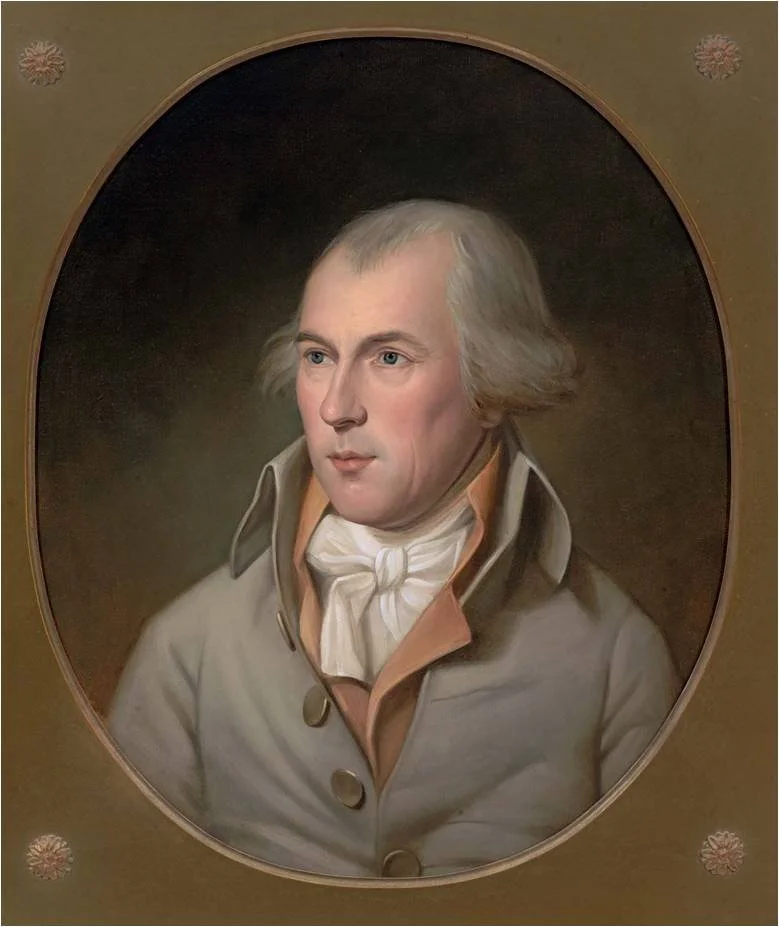
Democracy’s Documents: James Madison’s Federalist #51
When the Constitutional Convention ended on September 17, 1787, ratification required approval by conventions in at least nine states. Opponents, fearing a stronger national government, quickly launched their opposition with arguments that appeared in a series of newspaper essays. The authors’ identities bore the names of famous Romans who opposed tyranny, such as Brutus and Cato. The Constitution’s defenders countered with a series of 85 essays in New York City newspapers from October 1787 to April 1788. Known collectively as The Federalist, they were signed Publius after a founder of the Roman republic. The authors were Alexander Hamilton, James Madison and John Jay. In time it became clear that Madison wrote Federalist #51.
His aim was to justify how the structure of the new government would ensure justice, the first purpose named in the Constitution’s Preamble. In Federalists #49 and #50, he had argued that proposals to constrain the power of the national government by resorting to occasional Constitutional conventions or frequent direct appeals to the people were prone to the dangers of temporary popular passions. In Federalist #51 he argued instead that the problem could be averted “by so contriving the internal [emphasis added] structure of the government” that the tendency for mischief by it could be prevented.
One safeguard was to make “each department . . . as little dependent as possible on those of the others for the emoluments annexed to their offices.” Supreme Court Justices, for example, would have lifetime appointments and pay that could not be reduced to protect their independence and ability to resist the president and Congress.
The Constitution would also give “to those who administer each department the necessary constitutional means and personal motives to resist encroachments of the others.” As Madison put it, the solution rested on the principle that: “Ambition must be made to counteract ambition. The interest of the man must be connected with the constitutional rights of the place.” In short, government officials in every branch of the government would jealously guard any effort to limit their power by those in another of the three branches:
“It may be a reflection on human nature, that such devices should be necessary to control the abuses of government. But what is government itself, but the greatest of all reflections on human nature? If men were angels, no government would be necessary. If angels were to govern men, neither external nor internal controls on government would be necessary. In framing a government which is to be administered by men over men, the great difficulty lies in this: you must first enable the government to control the governed, and in the next place oblige it to control itself.”
The Constitution’s internal checks and balances offer what Madison called “auxiliary precautions.” For example, since “the legislative authority necessarily predominates,” (which was the assumption and intent of the framers who feared executive power) the corrective against abuses by Congress is “to divide the legislature into different branches” with “different modes of election and different principles of action.” As another example, the presidential veto would serve as a check on the Congress.
The Constitution, beyond the structure of the national government, offers another safeguard against tyranny. As Madison noted, it creates a “compound republic” of “two distinct governments” – the national and state governments. The power “allotted to each” level in this federal system is then further “subdivided among distinct and separate departments” at each level. As the three branches at the national level check each other so too can the three branches in each state. All of this creates what Madison calls “a double security.” “The different governments will control each other, at the same time that each will be controlled by itself.”
The beauty of this arrangement, Madison notes, solves another problem. The electoral majority rules in a republic. An overbearing majority is thus a threat to justice against an oppressed minority. Yet even a temporary majority must worry that a turn of fate could make it the minority. The “compound republic” and the “double security” help address the problem of majority tyranny.
If all these safeguards seem a prescription for structured chaos and gridlock, that was fine with the framers. They wanted “energy” in national government but not at the expense of justice.
Whether the structure of the Constitution protects equally against injustice today is a core question of our times. The framers assumed Congress would be stronger than the president. They did not foresee the rise of political parties or that the same party could dominate the Congress, the Executive Branch and the Judiciary. They assumed each branch of government would resist encroachment by the others.
“Justice is the end of government. It is the end of civil society,” Madison wrote toward the end of Federalist #51. “It has ever been and ever will be pursued until it be obtained, or until liberty be lost in the pursuit.” Our challenge is the same the framers faced: to ensure justice and liberty by an effective structure of the Constitutional system.
Photo Credit: Bradley Stevens after Charles Willson Peale