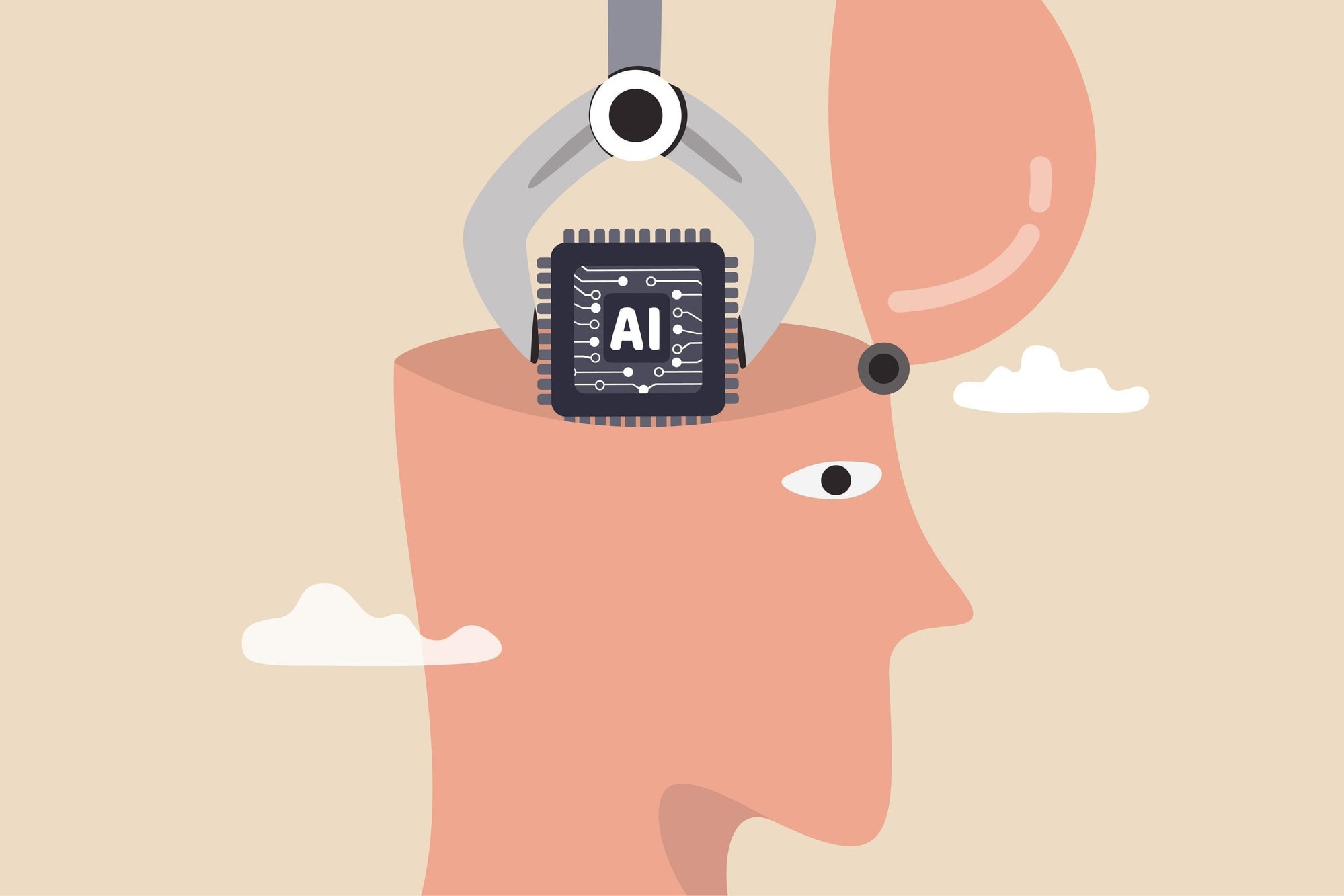

Outsourcing Thinking: A Danger with AI
In June 2025 UCLA student Andre Mai completed his final course paper using ChatGPT during his graduation ceremony. Caught on the Jumbotron he denied cheating on the assignment but reactions were certainly not all positive. Educators at all levels are facing such problems. Generative Artificial Intelligence (AI) is allowing students to search for information faster than traditional search engines permit, pose questions for which they can get narrative responses as well as structured summaries and even get crafted essays on any assigned topic. On the positive side, students have access to information that even a few years ago would have been accessible only with great difficulty. On the negative side, how do educators know what students are producing is the result of their thinking rather than the work of software that enables them to put their brains on idle?
Solving this problem is leading some educators to the return to methods such as in-class proctored essays, but that is the surface part of the AI problem iceberg. Ill-used, AI limits the need of students (adults too!) to learn how to research a topic, sift intelligently through sources and do the work of critical thinking. That work involves analysis, developing a point of view, applying original thought, exercising creativity and writing a coherent, reasoned argument. AI misused thus encourages surface understanding. It can breed students’ over-confidence in what they know. AI can also provide factually incorrect and/or biased information because an AI bot is programmed to please (to keep us online) and is ultimately no better than what it has been trained on. Where its database draws on fake news or has been corrupted by bias, its output will reflect that.
In psychology, what generative AI offers has an academic label: cognitive easing (or cognitive offloading). Cognitive easing provides a way to replace rigorous thought with something that is easy and effortless. In short, through cognitive easing we can outsource a lot of thinking.
AI’s potential threat to thinking shows up in other aspects of the technology. In generative AI systems, such as ChatGPT, the response to a posed question often includes suggested further questions AI can answer, prompting users to just say “yes” to that next step. This guides users rather than forcing them to evaluate what has already been produced and form their own queries, a key part of critical thought.
These systems learn about the user not only from a given encounter but from every other query made at other times. Aiming to please AI can thus learn how users think and what they care about. By drawing upon users’ earlier queries AI can pave a path to confirmation bias by spitting out information that strengthens a user’s existing train of thought while failing to provide information that could challenge it.
Cognitive easing through the use of generative AI shows up in more than classrooms. As just one example, lawyers on both sides of a Mississippi contract dispute were recently sanctioned and fined by U.S. District Court Judge Sharion Aycock for just being, in her words, “rubber stamps” for case citations that they drew from generative AI. The cases cited didn’t exist. AI may produce such “hallucinations” to satisfy users’ wishes.
The chief antidote to cognitive easing is, of course, users who stop to think. Nobel Laureate in Economics Daniel Kahnemann, in his book Thinking, Fast and Slow, described two styles of thinking revealed by research. System 1 is applied to routine, easy problems. It is fast, automatic, takes little energy and is the “first word” on any problem. Very efficient, it is called upon in many routine situations where careful thought is unnecessary. It draws on learned mental models and routines. For example, using previously learned routines means we don’t have to spend much mental energy on deciding what to do as we get up, get dressed, have breakfast and prepare to start the day. System 2, on the other hand, is not automatic. We must turn it on. It’s slower, requires careful thought, takes mental energy and can question mental models and routines. We need System 2 for complex problems, such as deciding on financial investments or a contractor for a major house renovation. Students (and lawyers) also need it when faced with assignments for which there is no simple answer.
The danger with generative AI is that it attracts us to use System 1, an easy and fast way to approach a problem, when we should be using System 2. The related danger is that if faced with pressures of time or expectations of others, such as the need to crank out a solution to a problem (e.g. a class essay) quickly, we may default to System 1 even if we know we should use System 2. That’s the attraction of generative AI.
“The mind is not a vessel to be filled, but a fire to be kindled,” quipped the Greek philosopher Plutarch. Cognitive easing through the use of AI gives us plenty of information but kindles no fire unless critical thought is applied to it. AI is no substitute for learning how to think. Only thought transforms information into knowledge, and only knowledge enriches us and solves significant problems.
Photo Credit: tim witzdam - unsplash.com