Profiles in Character: FDR and George Marshall Put Country Over Popularity to Prepare America for War
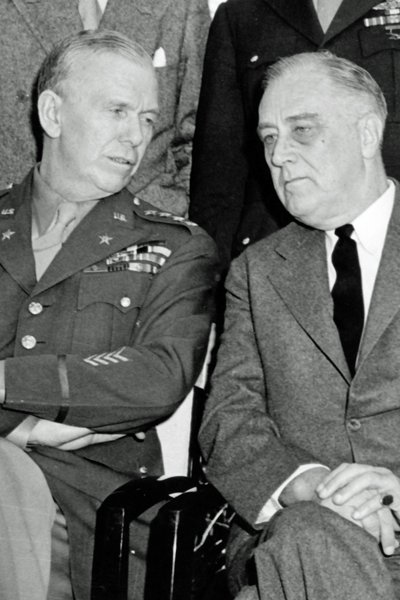
On September 1, 1939, the day Hitler invaded Poland, General George C. Marshall was sworn in as Army Chief of Staff, the nation’s highest military post. President Roosevelt had chosen him over thirty-three more senior officers in part because he appreciated that Marshall would disagree with him and always put the interests of the country first.
Marshall faced a herculean task. The nation’s armed forces – at 174,000 men – ranked just below the size of the army of Bulgaria. Isolationist sentiment was strong. Americans did not want their sons sent into another foreign war. FDR and Marshall, however, believed that building up the nation’s military, depleted after World War I, was essential given events in Europe.
A volunteer force was rejected as insufficient, but the nation had never had a draft in peacetime. In 1940, the President running for an unprecedented third term knew that opposition to a draft and the fear of entry into World War II could sway voters against him. When France fell in June, the chances for a draft bill somewhat improved. “A Bill to Protect the Integrity and Institutions of the United States through a System of Selective Compulsory Military Training and Service” was introduced in the House on June 20th by Republican James Wadsworth. Sen. Claude Pepper, a supporter, was soon hanged in effigy outside the Capitol by the Congress of American Mothers. Congressman Martin Sweeney called the bill a trick to drag America into the war.
On July 31st, FDR openly backed the bill. Marshall had testified in support of it a week earlier but went further on August 7th with a request for $4 billion to support the force a draft would create. He could have waited until the draft passed instead of inflaming the opposition, but as he told isolationist Sen. Gerald Nye: “My fear is not that I am recommending too much but rather that I may find some time in the future that I have recommended too little.”
The bill passed on September 14th and was signed into law by FDR two days later. The Selective Service and Training Act required all men between 21 and 36 to register for the draft. Inductees would serve just a year and could not enter combat in any “foreign war.” On October 29th, Secretary of War Henry Stimson drew the first draft lottery number, a celluloid capsule from a 10-gallon fishbowl stirred with a wood spoon made from a beam from Independence Hall. He handed it to FDR, who announced the number. The President might have spared himself the task and political exposure but remarked that this would have been “cowardly.”
In the summer of 1941, the one-year commitment of draftees was just a few months away. Yet events in Europe had continued to deteriorate. Concerned the army they were building would soon evaporate, FDR and Marshall supported Wadsworth who introduced a bill to extend draftees’ commitment. Opposition was intense, especially among draftees who started scrawling “OHIO” on barracks walls, threatening to just quit: “Over the Hill in October.” A New York Times ad by 240 educators said “peacetime conscription and American democracy are quite incompatible.”
FDR asked Marshall to take the lead in Congress. As House Speaker Sam Rayburn once put it: “When General Marshall takes the witness stand to testify, we forget whether we are Republicans or Democrats….We know we are in the presence of a man who is telling the truth.” When Marshall met with a group of Congressional Republicans, one told him “You put the case very well, but I’ll be damned if I am going to go along with Mr. Roosevelt.” Marshall was incensed: “You are going to let plain hatred of the personality dictate to you to do something that you realize is harmful to the interest of the country!”
Norman Thomas, the perennial socialist presidential candidate branded Marshall FDR’s puppet. The president, seeing that the draft extension hung by a thread, on July 21st put his full weight behind it in a national radio address: “beginning this autumn,” he told Americans, “the Army of the United States will begin to melt away.”
On August 12th, House debate began. In a long day with no break for lunch or dinner, members fought. Congressman Usher Burdick claimed that the draft extension was not needed to help save Europe because “Germany has not yet been able to swim the English Channel” and that “It is nothing but a pipe dream to think Germany could land troops in the United States.” After ten hours, Rayburn felt he still lacked the votes for passage. The final tally near 9:00 p.m. was 203-202 for approval. The Senate passed the extension on August 14th and FDR signed it on August 18th. Less than four months later, Japan attacked Pearl Harbor. The single-vote margin in the House kept the fledgling army alive.
Politically astute FDR navigated between Americans opposed to war and the need to prepare for it with excellent timing, courage, prudence and knowing when to let others take the lead. Marshall’s voice was heard because of his reputation for honesty and sound judgment.
Photo Credit: Marshall Foundation