Your Political Opponents are Not Immoral
Do the homeless deserve caring and attention or are they dangerous and a threat to law and order? Do immigrants deserve to be deported or should they be given a path to citizenship? Political partisans disagree on such issues, sometimes vehemently, though compromise would help solve such problems and be healthy for our democracy. Yet extreme partisanship has made compromise on many issues impossible. One complicating factor is what we think about those who disagree with us. A 2022 Pew Research study found that seventy-two percent of Republicans view Democrats as “immoral” and sixty-three percent of Democrats say Republicans are “immoral.”
Admittedly, there is evil in the world. If immorality was that widespread, however, the social cohesion essential for civil society would not exist. For the most part it does. The problems that plague much of our politics may instead be due at least in part to how political opponents make moral judgments on issues. The vast majority of Democrats and Republicans are not immoral but what they think morality requires on a given issue may well differ. That difference can make people politically blind: they can’t see things from opponents’ perspectives and resort to attacking their positions and them.
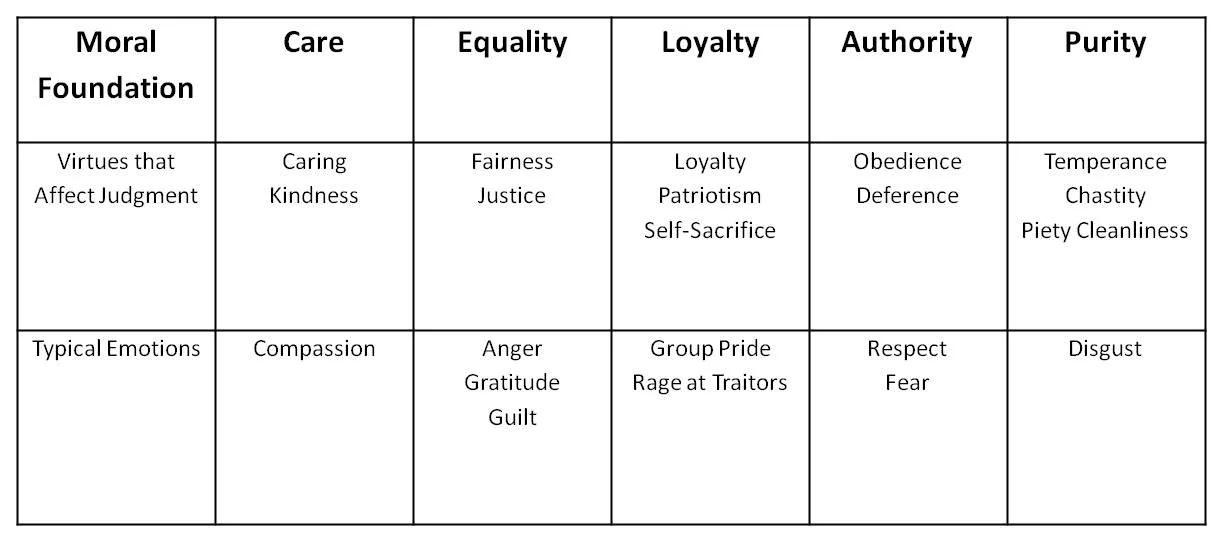
Social psychologist Jonathan Haidt has confronted this possibility in research that led to Moral Foundations Theory (MFT). Popularized in his book, The Righteous Mind: How Good People are Divided by Politics and Religion, Haidt argues that traditional ways of thinking about morality assume we’re solely rational beings and thus ignore that morality is deeply grounded in our emotions. MFT suggests that our positions on issues reflect one or more of five moral foundations that anchor our thoughts and actions. These moral foundations, he says, arise from the interplay of innate (genetic) predispositions - evolutionary forces that enhanced human survival - and cultural forces that shape the content and strength of each foundation.
Haidt’s five moral foundations are shown below with a simplified listing of the virtues that affect moral judgments and the typical emotions each foundation rests upon/generates.
Moral Foundations Theory
Research on MFT has found that both those who identify as politically liberal and those who identify as conservative can draw on all five moral foundations in decision making but don’t give them the same importance. Liberals give the most weight to Care and Equality while conservatives weigh all five foundations in looking at issues. This, for example, can help explain why on immigration liberals are especially concerned with compassion for undocumented people and their children (especially in confinement and in proceedings) and get angry when they see what seems unjust and unfair. It’s not that conservatives are blind to these virtues and emotions but that they will balance them with stronger expectations for respect and deference to authority and expect immigrants to obey laws and regulations, getting angry when immigrants and protesters do not.
Moral Foundations Theory can help us think more carefully and less rigidly about both tough political issues and the sides people take on them. Differences can be understood in part as the result of the strength of different moral foundations for both those who agree and disagree with us. Insisting that opponents are ignorant or dismissive of the facts we possess ignores the power of virtues and emotions that underlie their views and choice of facts.
Moral Foundations Theory also suggests that one way to gain support on an issue is to provide stories of how ignoring it violates moral foundations. Citizens of a local community who want to spur funding from local officials for a summer jobs program could, for example, show stories of how unemployed teens have been involved in minor crimes (moral foundation of authority) and how those with jobs have helped improved community relations (moral foundation of care).
Political compromise may be more achievable if we can find solutions that play to the moral foundations that underlie both sides on an issue. For example, conservatives who want a crackdown on the spread of the homeless into public spaces, which violates their concerns about cleanliness and obedience to authority, might gain liberals’ support by working with officials to provide funding for mental health and affordable housing to address concerns about caring and kindness. Liberals, for their part, could in turn support ordinances and their enforcement to make public spaces free of homeless encampments.
MFT is, of course, still a theory. Research continues to test its validity and usefulness. A chief contribution at present may be to help people get beyond the tendency to label those who see an issue differently – political or otherwise – as stupid and immoral.
To explore MFT theory and assess your own moral foundations, go to www.yourmorals.org .
Photo Credit: adobe image