
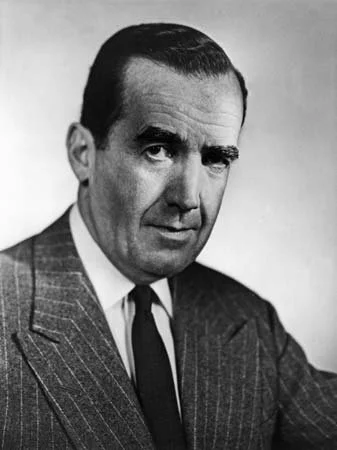
Profiles in Character: Edward R. Murrow Argues that Sen. Joseph McCarthy Threatens Democracy
Edward R. Murrow was a pioneer in broadcast journalism, first in radio and then on television. His broadcasts from London during World War II and his TV program See It Now set a high standard for truth and integrity in reporting. Republican Senator Joseph McCarthy rose to prominence in the anti-communist atmosphere after the war, beginning with his 1950 speech claiming he had a list of communists who worked in the State Department. Throughout the early 1950s his attacks grew increasingly angry and politically divisive, usually with no factual evidence. On March 9, 1954 Murrow devoted his entire half-hour program to criticism of McCarthy and the danger he presented. His broadcast played a key role in launching hearings that would eventually lead to McCarthy’s downfall.
Murrow began by saying that “[I]f this fight against communism is made a fight between America’s two great political parties, the American people know that one of these parties will be destroyed, and the Republic cannot endure very long as a one party system.” He then noted that it was McCarthy who said those exact words seventeen months earlier.
Murrow then said McCarthy violated his own warning, citing his February 4, 1954 comment that “the hard fact is that . . . those who wear the label ‘Democrat’ wear it with the stain of a historical betrayal.”
Murrow elaborated on McCarthy’s threat to truth and democracy:
“Often operating as a one-man committee, he has traveled far, interviewed many, terrorized some, accused civilian and military leaders of the past administration of a great conspiracy to turn over the country to Communism, investigated and substantially demoralized the present State Department, made varying charges of espionage . . . has interrogated a varied assortment of what he calls "Fifth Amendment Communists.””
He cited several examples. McCarthy, chair of the Senate Committee on Government Operations, had on March 4, 1953 charged Reed Harris, Deputy Administrator of the State Department’s International Information Administration, for using the Voice of America to support communism, despite much praise for Harris’s work and no evidence of the veracity of the charge. Murrow attacked McCarthy for going after decorated Gen. Ralph Zwicker on February 18, 1954, which led to President Eisenhower defending Zwicker against McCarthy’s treatment. Murrow also noted McCarthy had threatened to sue fellow Sen. William Benton (D-CT) for Benton’s speech on September 29, 1951 that included ten actions McCarthy had taken that Benton argued warranted his censure. McCarthy had days before threatened to sue Adlai Stevenson for his March 6, 1954 speech in which, while not naming McCarthy, he said: “"We are witnessing the bitter harvest from the seeds of slander, defamation and disunion planted in the soil of our democracy."
Murrow, moving to the most remembered part of the program, reminded Americans how ethical government officials, reasoned argument and civility should steer the democratic ship and had done so throughout our history:
“No one familiar with the history of this country can deny that congressional committees are useful. It is necessary to investigate before legislating, but the line between investigating and persecuting is a very fine one and the junior Senator from Wisconsin has stepped over it repeatedly. His primary achievement has been in confusing the public mind, as between the internal and the external threats of Communism. We must not confuse dissent with disloyalty. We must remember always that accusation is not proof and that conviction depends upon evidence and due process of law. We will not walk in fear, one of another. We will not be driven by fear into an age of unreason, if we dig deep in our history and our doctrine, and remember that we are not descended from fearful men -- not from men who feared to write, to speak, to associate and to defend causes that were, for the moment, unpopular.”
The preservation of freedom, Murrow said, required every citizen to take responsibility for it:
“This is no time for men who oppose Senator McCarthy's methods to keep silent . . . We can deny our heritage and our history, but we cannot escape responsibility for the result. There is no way for a citizen of a republic to abdicate his responsibilities. As a nation we have come into our full inheritance at a tender age. We proclaim ourselves, as indeed we are, the defenders of freedom, wherever it continues to exist in the world, but we cannot defend freedom abroad by deserting it at home.”
The fault, the danger to America, lies not only with McCarthy, Morrow added:
“The actions of the junior Senator from Wisconsin have caused alarm and dismay amongst our allies abroad, and given considerable comfort to our enemies. And whose fault is that? Not really his. He didn't create this situation of fear; he merely exploited it -- and rather successfully. Cassius was right. "The fault, dear Brutus, is not in our stars, but in ourselves."
Morrow ended his broadcast with his signature sign-off, a line he had picked up during the blitz in 1940 when Londoners would end their day, not knowing if they would survive the night and so said to each other: “Good night and good luck.”
McCarthy would be officially “condemned” by the Senate on December 2, 1954 after two months of hearings. Though he continued to serve for another two-and-one-half years, his power was greatly diminished, and he was mostly ignored as a political figure. He died on May 2, 1957.
Photo Credit: wikipedia.org