Profiles in Character: John Marshall Helps Thwart a Presidential Election Coup
Organized political parties faced each other for the first time in the nation’s history in the presidential election of 1800. Sitting President John Adams, a Federalist, faced his own Vice-President, Thomas Jefferson, a Democratic-Republican. The campaign was bitter and though Jefferson prevailed in the Electoral College by a 73-65 margin, he was tied with his own running mate, Aaron Burr. Since the framers of the Constitution did not anticipate political parties, they wrote that a tie in the electoral vote would be decided in the House of Representatives, with each state’s delegation having one vote.[1]
While the election swept the Democratic-Republicans into control of both houses of Congress, that Congress by law would not convene until December 1801. The House elected in 1798 would thus decide the election between Jefferson and Burr. That House was controlled by Federalists.
In early 1800, sensing the possibility of a Jefferson victory in the fall election, Federalist Senator James Ross of Pennsylvania took action. On January 23 he introduced a bill to create a “Grand Committee” to serve in deciding “disputed elections of President and Vice-President.” The bill provided that the Senate and House would each choose six-members for the Committee, which would be chaired by the Chief Justice of the Supreme Court. It would have the authority to operate in secret, investigate supposed electoral vote irregularities and issue its decision on March 1, 1801, three days before the presidential inauguration. Neither chamber of Congress nor the candidates could challenge its decision.
Since both the Senate and House were controlled by Federalists and Chief Justice Oliver Ellsworth was also a Federalist, enactment of Ross’s bill if signed by Federalist President John Adams could assure Federalist control of the coming presidential contest. This would over-ride the provisions of Article II of the Constitution and undermine the still-fragile republic. When news of the proposed legislation became public, Democratic-Republicans rose in anger. The bill passed the Senate so it would take Federalist opposition in the House to stop it.
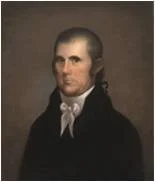
Congressman John Marshall of Virginia had been elected in 1798. He had fought in the Revolutionary War and was a staunch proponent for ratifying the Constitution. He was known as a moderate Federalist and though a second cousin to Jefferson, strongly opposed his fellow Virginian.
As a constitutionalist, however, the Ross bill was unacceptable to Marshall. In the House he had to work against arch-Federalist House Speaker Theodore Sedgwick to kill it. Joined by other moderate Federalists, Marshall pushed back and Sedgwick agreed to hold off final consideration of the bill until December 1800, when the likely outcome of the election would be known and any supposed Electoral College irregularities would need investigation.
Marshall then began proposing amendments to Ross’s bill. By mid-April, Sedgwick was forced to send the bill to a committee to consider the amendments. The House bill that emerged gave Ross’s “Grand Committee” only the power to announce the votes, not investigate or invalidate any of them. The House passed this bill and sent it to the Senate for its consideration. The Senate never acted so when Congress adjourned for the year on May 2, the proposed legislation died.
The crisis had been averted, or so it seemed. While Burr had campaigned as Jefferson’s running mate and said he had no intention to seek the presidency, the tie vote with Jefferson in December gave him hope. Arch-Federalists who hated Jefferson and had lost in the battle over the Ross bill saw a way to put Burr into the Executive chair.
The electoral votes confirming the Jefferson-Burr tie were officially counted and announced in the Senate on February 11, 1801 with Vice-President Jefferson stoically performing his Constitutional role to do so. The House went into immediate session, and it would take 36 votes over 6 days before Jefferson emerged the winner.
During this period, various Federalist schemes were tried to give the presidency to Burr. All failed. One involved dragging House voting past the March 4th inauguration date and then having the Federalist Congress appoint a temporary president until new elections could be held in the fall. Marshall, at that point out of Congress and now Chief Justice of the Supreme Court, was proposed for this role but wanted no part in it.
John Adams, his presidency nearing an end, had nominated Marshall for Chief Justice and he had been confirmed in late January. He took up his post on February 4, 1801. As Jefferson rose to take the Oath of Office on March 4th, it was thus John Marshall, a Federalist, who swore him in. Marshall, having twice acted to preserve the rule of law under the Constitution, thus assured the first peaceful transition of power in American history.
Marshall would serve until his death in 1835, the longest tenure for a U.S. Chief Justice of the Supreme Court.
[1] This problem was corrected with the 12th Amendment, ratified in 1804 which required that electors “shall name in their ballots the person voted for as President, and in distinct ballots the person voted for as Vice-President.”
Photo Credit: Painting by Cephas Thompson - media.wikimedia.org